

What is the Centerline Radius (CLR) of a Bend?
We are frequently asked to clarify what Centerline Radius, often written as CLR, means. The CLR of a bend is the distance from the center of the bending die to the centerline (axis) of the tube or pipe. Picture the bend as part of a circle: the CLR is the radius of that circle, measured to the middle of the tube rather than to its inside or outside edge.
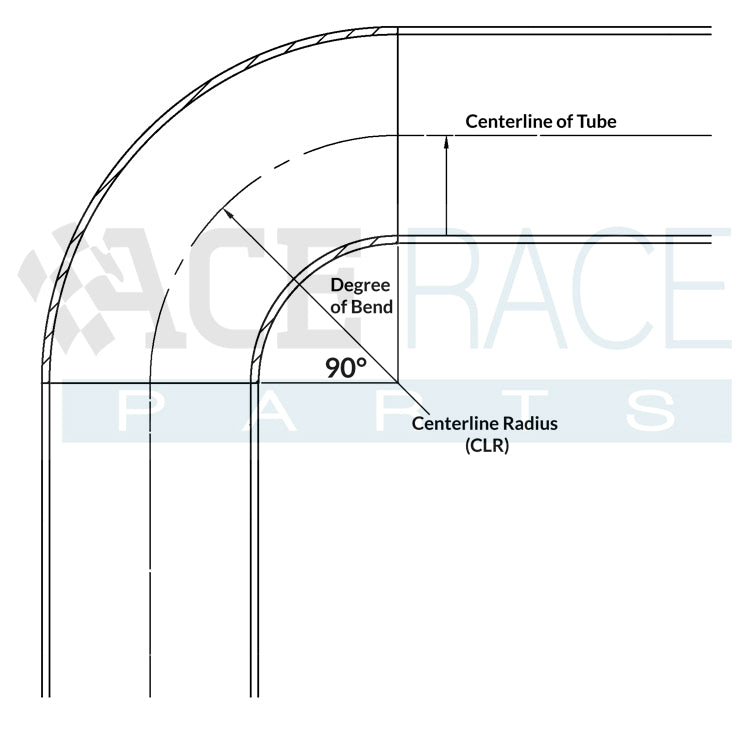
Why CLR Matters
When fabricating a set of headers, a downpipe, intercooler piping, or an exhaust system, the CLR is one of the most important dimensions to pay attention to. If a bend's radius is too tight or too loose for the space it has to fit, the finished part may not fit, or the inlet and outlet may end up out of alignment.
Many builds use a mix of radii. A set of headers might need both standard and tight radius bends, and a custom downpipe might need the tightest bend available to clear an existing part of the vehicle. Knowing the CLR, and knowing how to measure it, is a key part of sourcing the right components for the job.
What Does "1.5D CLR" Mean?
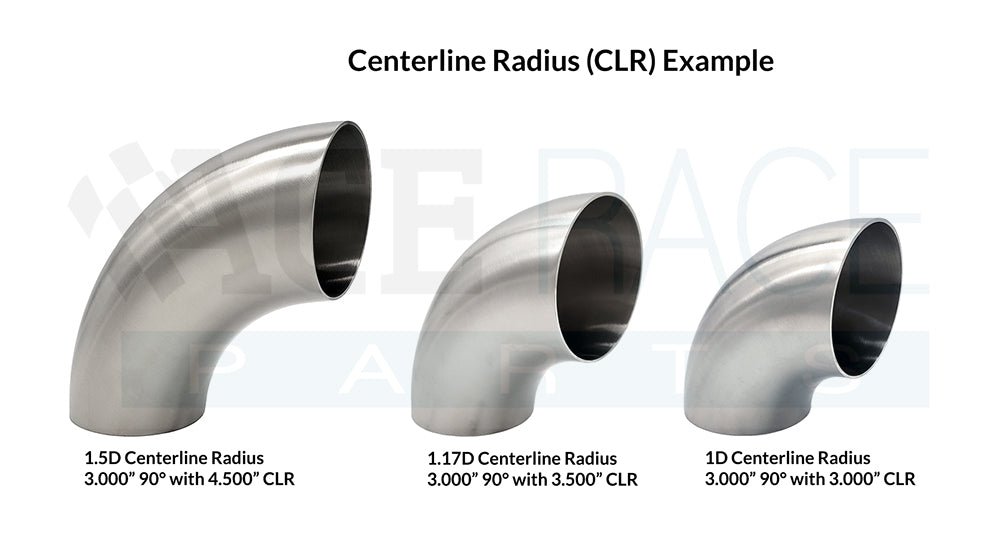
The "D" figure is a multiplier of the tube's outside diameter. A bend with a 1.5D CLR has a centerline radius equal to 1.5 times the OD of the material. For example, a 3.000" OD 90° bend with a 1.5D CLR has a centerline radius of 4.500" (3.000 × 1.5 = 4.500).
For pipe, which uses nominal sizing, the formula uses the nominal size rather than the actual OD of the material. (See Pipe Size vs. Tube Size for more on how pipe and tube are sized differently.)
The larger the number in front of the "D," the more gradual the bend. A 1D bend is tighter than a 1.2D bend, and a 1.2D bend is tighter than a 1.5D bend.

Common CLR Values by Tube OD
| Tube OD | 1D CLR (Tight Radius) | 1.5D CLR (Standard) |
|---|---|---|
| 1.500" | 1.500" | 2.250" |
| 1.750" | 1.750" | 2.625" |
| 2.000" | 2.000" | 3.000" |
| 2.250" | 2.250" | 3.375" |
| 2.500" | 2.500" | 3.750" |
| 3.000" | 3.000" | 4.500" |
| 3.500" | 3.500" | 5.250" |
| 4.000" | 4.000" | 6.000" |
Calculated values. Some tight radius bends fall between 1D and 1.5D, so always check the CLR listed on the specific product. Nominal dimensions; tolerances apply.
Standard, Tight, and Sweeping Radius
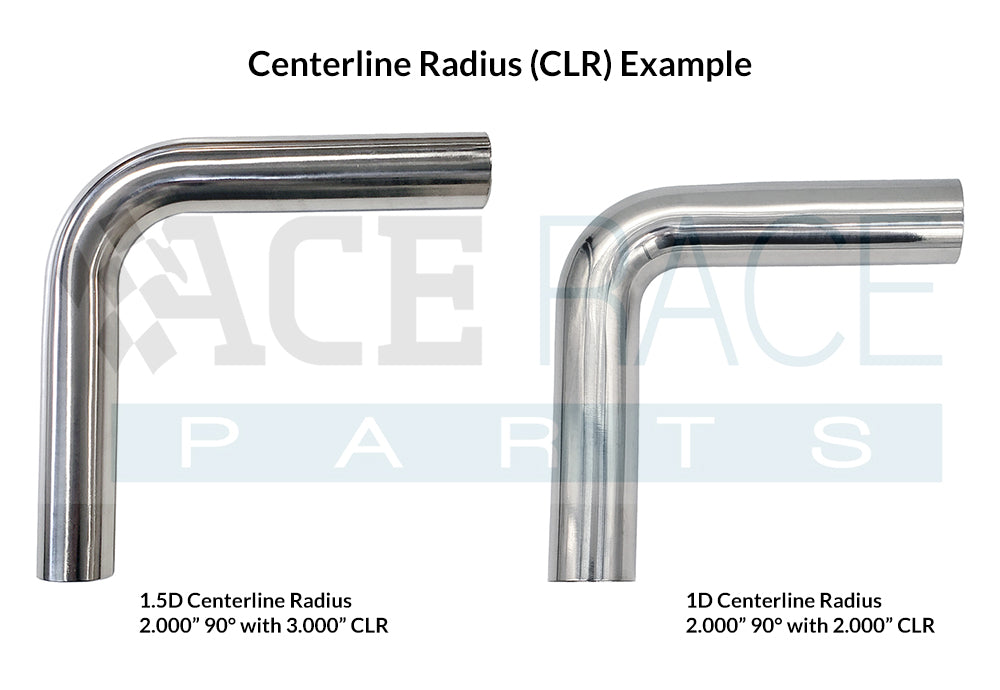
Most mandrel bends for tube are made with a 1.5D CLR, which is considered the "standard" radius. Anything tighter than 1.5D is usually called "tight radius." Bends with a radius larger than 1.5D are often called "loose radius" or "sweeping radius" bends.
For nominal pipe size material, where most elbows have no tangents or "legs," the CLR is often called the "center to face" dimension.
The images below show some of our products and how the CLR is measured on each style.
How to Measure the CLR of an Existing Bend
If you are matching or replacing a bend, you can find its CLR with a tape measure or calipers and a flat surface.
90° Bend Without Legs

- Measure the tube OD.
- Stand the bend on a flat surface with one end face flat against a wall or a square.
- Measure from the wall to the outside edge of the opposite end of the tube.
- Subtract half the OD. The result is the CLR.
Example: a 3.000" OD bend measures 6.000" from the wall to the outside edge. 6.000" − 1.500" = 4.500" CLR, which is a 1.5D bend.
You can also measure to the inside edge of the opposite end and add half the OD. Both methods should give you the same number.
Bends With Legs or Tangents

Many mandrel bends have straight sections, called legs or tangents, of equal length on both ends. These add length beyond the bend itself. On a 90° bend with legs, the center-to-end measurement equals the CLR plus the leg length.
- Measure center-to-end using the same wall method above (outside edge minus half the OD).
- Measure the straight leg on the end that is against the wall, from where the bend ends to the end face of the tube.
- Subtract the leg length. The result is the CLR.
Example: a 2.500" OD 90° bend with 6.000" legs measures 9.750" center-to-end. 9.750" − 6.000" = 3.750" CLR.
Measuring From the Inside and Outside Radius
If you can measure the inside radius (the tight side of the bend) and the outside radius (the long side), the CLR is halfway between them. Add the two together and divide by two.
Choosing Bends for Your Build
CLR is one of several things to work through when picking mandrel bends, along with size, alloy, angle, and whether you need legs. Our Mandrel Bend Selection Guide walks through each one.
Shop mandrel bends in 304 stainless, 316L stainless, 6061 aluminum, and CP1 titanium. The CLR is listed on each product page. Questions about a specific bend? Email us at sales@aceraceparts.com.
Comments
Leave a comment